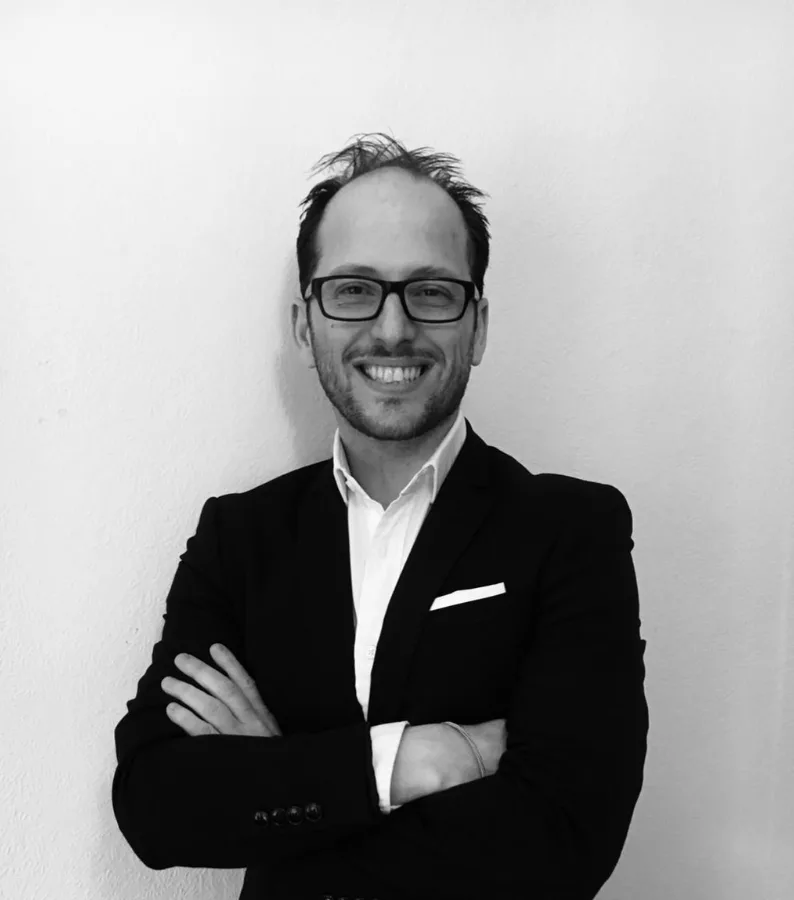
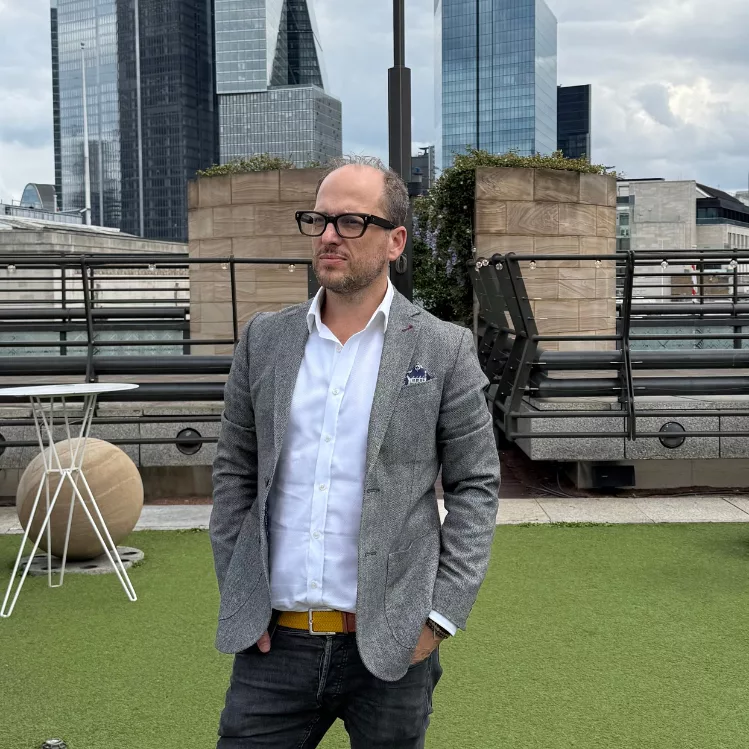
Meet Jeremy Laight: The Accidental Fractional CMO
Jeremy Laight didn’t set out to become a fractional CMO—he stumbled into it. After leaving what seemed like a dream role in London’s fintech scene, he faced a slow job market and a career crossroads. What began as a detour quickly became a new way of working: providing senior marketing leadership to ambitious companies without the cost or commitment of a full-time hire.
Through his work with a diverse portfolio of businesses and his community, The Slice, Jeremy has helped redefine what it means to lead in marketing—proving that impact doesn’t require a 9-to-5. His journey is a story of curiosity, creativity, and the freedom to shape a career on your own terms. And as fractional working becomes mainstream around the world, he is committed to helping others make the most of this new pathway.
“I became a fractional CMO by listening to what founders truly needed.”
What led you to choose the fractional CMO path instead of a traditional full-time role?
My fractional journey didn’t start with strategy; it started with redundancy or should I say redirection. I’d just left what felt like a dream role at a London fintech, and when I re-entered the job market the permanent side was unusually sluggish. My coach encouraged me to stop relying on job boards and instead tap into what they called the “hidden market”, which meant raising my profile, sharing my thinking publicly and having far more intentional conversations.
What happened next genuinely surprised me. Founder-led businesses began approaching me repeatedly, not for a full-time CMO role, but for access to senior marketing leadership without the cost, the risk or the permanence. They were wrestling with the same questions: was it the right time, did they truly need someone five days a week, and how could they de-risk such a significant hire?
What I realised was that the fractional model solved a problem on both sides. They gained strategic leadership without the overhead, and I gained the freedom to work where I add the most value. Inside a small portfolio of ambitious brands, while still having space for personal projects and charitable work. It didn’t start as a grand career plan; it evolved naturally because I simply listened to what the market, and founders, were actually asking for.
How would you explain what a fractional CMO does to someone who’s never heard the term before?
I explain it through a simple lemon analogy. Imagine your time as a lemon. In a traditional career you hand the whole lemon to one employer, and it belongs entirely to them. Fractional work involves slicing that lemon and sharing it across several businesses and projects, sometimes including passion work or charitable initiatives or experiments you want to explore. Sometimes you even keep a slice for yourself or your family.
That thinking is what inspired the name of my community for fractional marketers, The Slice.
So in essence, a fractional CMO gives a company senior leadership, clarity and momentum, just not full-time. It’s meaningful impact without the full-time overhead.
What kinds of businesses benefit most from working with you and RocketJam?
I’ve worked across financial services, healthcare, logistics, professional services, multinational corporations and early-stage scale-ups. But sector isn’t the defining factor; intent is.
The organisations that benefit most are the ones hungry for change and who view marketing as an investment that will help them transcend their current stage of growth. Sometimes that looks like launching a new product or refreshing a brand. Sometimes it’s about building a modern marketing capability or team. Often it’s a company that has simply outgrown its old way of doing things and needs senior clarity, structure and pace to get to the next level. In many cases, I am their first-ever CMO, helping design both the strategy and the capability that will propel them forward.
What inspired you to start The Slice, and what makes that community special?
When I first became a fractional CMO, I made every mistake imaginable – pricing, positioning, pipeline, all of it. I kept thinking how strange it was that there wasn’t a place for people navigating this path. At events I’d meet other fractionals who felt similarly: talented and ambitious, yet oddly disconnected. Their “team” existed across clients, Slack channels and Zoom calls. There was no real home base, no sounding board, no shared learning environment.
The Slice was created to fill that gap. A dedicated home for fractional marketers to connect, collaborate and build sustainable portfolio careers. What makes it special is the philosophy behind it. We’re not built on gatekeeping or exclusivity or high-priced memberships. We’re built on community. I genuinely believe a rising tide lifts all boats, and that mindset is at the heart of everything we do. When you’re building a portfolio career, your network truly becomes your net worth. But I’m also lucky to have an amazing co-founder by my side, Catherine Nichols. We challenge and encourage each other daily – I don’t believe you can achieve success on your own.
You’ve worked in big companies and in startups — what’s the biggest difference in how they approach marketing?
The principles of marketing don’t change, but the conditions absolutely do. Big companies offer scale, structure and process, but they also come with layers, complexity and inertia. Startups are the opposite. They move quickly, think creatively and act decisively, but they often lack time, budget and foundational systems.
Ironically, smaller budgets often force sharper thinking and higher creativity. There’s nowhere to hide, so the impact of smart decisions is felt immediately. What’s fascinating now is how AI and accessible tech have levelled the playing field. A fractional CMO with the right stack and a small freelance bench can build a modern, high-performing marketing engine quickly and affordably. Scale is no longer the advantage it once was.
What’s one common mistake you see businesses make when trying to grow quickly?
The biggest mistake is forgetting the fundamentals. Many companies sprint towards lead generation before properly understanding their customer. They jump into tactics before establishing clear positioning. They chase momentum without building the systems and infrastructure that allow growth to repeat and compound.
I often compare brand building to getting in shape. You don’t go to the gym once and expect results. You commit, you repeat, you refine. Marketing works the same way. And because it’s both a science and an art, I often say: if you’re not measuring, you’re not marketing. If you don’t know why something worked, you won’t be able to scale it.
You talk a lot about AI in marketing — what’s one simple way a company can use AI today without overthinking it?
Start with an AI-first mindset. There’s an analogy I love: imagine digging a hole with your bare hands while a shovel sits beside you. You can absolutely use your hands, but you’ll be exhausted long before you make progress. Or you can pick up the shovel and move exponentially faster. AI is that shovel. In fact AI is an excavator that can move mountains.
So before you begin any task – whether research, writing, analysis or planning — ask yourself how AI can help you do it faster, better or with more precision. That single habit is transformative.
What keeps you excited about marketing after 20 years?
Marketing is an endless pursuit. You never truly “arrive”. Across my career alone we’ve lived through the birth of smartphones, the rise of social media, the explosion of SaaS, automation and now AI. Each wave forces you to rethink what’s possible.
But what keeps me energised is the combination of intellectual challenge and human connection. I love working with new teams, new founders, new ideas. I love the thrill of seeing something you’ve built turn into tangible impact – the phone ringing, the pipeline growing, the business shifting gears. That feeling never gets old.
How do you stay creative and keep your ideas fresh?
Creativity matters more than ever because as content production accelerates, originality becomes the differentiator. AI can remix the past, but only humans can generate the truly new.
For me, creativity comes from curiosity. I keep learning. I meet people outside my usual bubble. I deliberately change routines. I consume content that isn’t related to marketing at all. Most of my best ideas come from unexpected conversations, not frameworks or textbooks.
What advice would you give someone thinking about becoming a fractional marketer?
Do your homework and then commit. Speak with people already working this way and understand the realities behind the glossy success stories. Fractional work doesn’t thrive when someone is half in and half out, secretly waiting for a full-time job to appear.
To succeed, you need clarity on who you serve, the problem you solve and how you position the value you bring. You also need to understand that you’re not just becoming a consultant – you’re becoming a business. That means owning your pricing, your pipeline, your positioning and your reputation.
But if you lean in with intent, fractional work can be one of the most rewarding, flexible and creatively fulfilling ways to build a career. It offers autonomy, impact and variety in a way few traditional paths can match. Of course join a community like The Slice too !!